The Canada Research Chair in Implementing Integrated Care for People with Complex Needs aims to promote optimal coordination of care for this population group, and improve transitions between the various health, social services and community network professionals.

Our Research Chair

The Canada Research Chair in Implementing Integrated Care for People with Complex Needs ultimately aims to transform healthcare systems to ensure greater health equity, and better health for people with complex needs.

Evidence supports the importance of integrating care between all professionals from different sectors to improve care for this population. Integration models, such as case management, aim to overcome the fragmentation of care and improve transitions of care between the different professional resources of the healthcare system and the community network. Health equity, health and health system performance are largely influenced by the care transitions of this population.

Knowledge users will be engaged throughout the projects to ask research questions relevant to them, and the most appropriate methods will be used to answer them.

Implementation involves deploying an intervention in a real healthcare and social services context.

The Chair's work is divided into two axis:

Axis I

Care transitions:

Better understand care transitions for people with complex needs: a) within the healthcare network (front-line and hospital); and b) between the healthcare network and the community network; and propose strategies to improve these transitions.

Axis II

Implementation:

Evaluate the implementation of case management in the healthcare system.

Each axis includes projects of national scope.

Canada research chair

News:

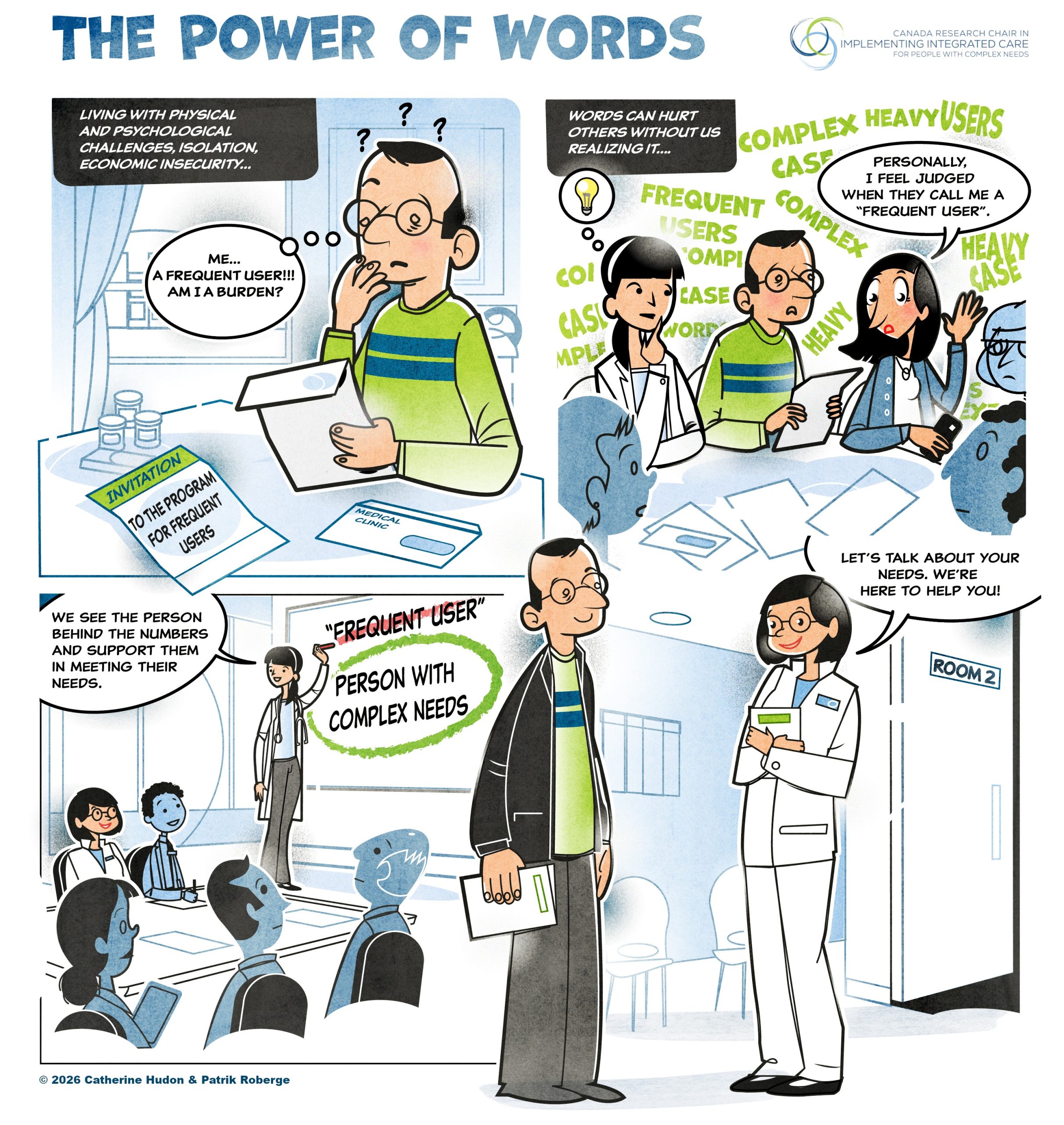
Comic strip «The Power of Words»

Comic strip «The Power of Words»

💬 What if we told the story of research differently?

Our new knowledge transfer tool, titled “The Power of Words”, is based on an article recently published in the International Journal for Quality in Health Care. We chose the comic strip format to broaden the possibilities for conveying a key message:

Referring to “frequent users” can reinforce prejudice and harm relationships of trust. Changing our language and instead speaking of people with complex needs promotes a more human, ethical, and inclusive approach to health care.

📖 Scientific article: https://lnkd.in/ecuzTrtR

🙏 Thanks to Patrik Roberge for the illustration, as well as to Catherine Hudon and Donna Rubenstein, co-authors of the article.

Logo de l'Université de Sherbrooke Logo CIHR IRSC